There’s a point in every fishing trip when you have to admit something you don’t particularly want to admit:
What you’re doing isn’t working.
After more than 35 years of fly fishing, I’ve learned to trust my instincts. I’ve spent decades reading rivers, watching weather, studying water temperature and current, recognizing feeding behavior, and making adjustments when conditions change.
But sometimes experience can work against you.
You get comfortable with the techniques that have produced fish for you over the years. You know the flies you trust. You know the presentations you’re confident in. You know how you like to fish.
And then the river changes.
The fish change.
And suddenly, everything you know seems to stop working.
That’s exactly what happened to me on a recent November trout trip.
After two days of struggling, I finally had to admit something I don’t particularly enjoy admitting after all these years:
It was time to change.
Two Days of Doing What I Always Do
November trout fishing can be a strange game.
Water temperatures are dropping. Insect activity changes. Trout become more deliberate in how they feed, and the aggressive feeding behavior of warmer months can disappear.
I started the trip fishing the way I normally would.
I worked the water carefully, looking for seams, deeper runs, current breaks, structure, and the places where I expected trout to hold. I changed flies. I changed presentations. I moved around and looked for different water.
But the results weren’t there.
The first day produced very little.
The second day wasn’t much better.
At some point, you stop blaming the weather, the water, the flies, or the fish.
You start looking at yourself.
And that’s when the real adjustment begins.
It Wasn’t Just Me
As the fishing continued, I started noticing something else.
I wasn’t the only angler struggling.
I watched several anglers around me changing flies over and over again.
They would open their fly boxes, tie on another pattern, make a few casts, then change again.
A different fly.
A different size.
Another color.
Then another.
But the result was the same.
Nobody was catching anything.
That caught my attention.
It was easy to assume the answer was somewhere inside the fly box. When trout aren’t eating, changing flies is usually the first adjustment most of us make.
But watching anglers cycle through pattern after pattern made me start thinking about the bigger picture.
What if the problem wasn’t the fly?
What if the trout weren’t necessarily rejecting the pattern?
What if they simply weren’t seeing it at the right depth, in the right current, or moving the way their food was moving?
That question stayed with me.
Because I was doing essentially the same thing.
I was relying on what had worked for me in the past instead of responding to what was happening in front of me.
The Problem Wasn’t the River
The biggest mistake I was making wasn’t necessarily choosing the wrong water.
It was assuming the fish were willing to play the game I wanted to play.
I was fishing according to what had worked for me for years.
The trout didn’t care.
They weren’t interested in my experience.
They weren’t impressed by the flies I had confidence in.
They were feeding according to the conditions in front of them.
And I wasn’t adapting quickly enough.
So I started asking a different question.
Instead of:
“What fly do I want to fish?”
I started asking:
“What are these trout actually eating, and how are they eating it?”
That was the turning point.
The Strategy I Had Avoided for Years
After two days of struggling, I finally decided to try something I had rarely used despite all my years of fly fishing:
tight lining small flies and drifting size 20 emergers and midges through the feeding lanes.
It wasn’t complicated.
It wasn’t glamorous.
And honestly, it wasn’t the way I wanted to fish.
But I was out of options.
After two days of not catching anything, catching fish had become more important than sticking with the methods I was comfortable with.
I rigged small flies and started concentrating on slower water and subtle feeding lanes where trout could hold without spending unnecessary energy fighting the current.
The presentation changed completely.
Instead of trying to make the trout come to the fly, I was putting the fly into the water column where the fish were already feeding.
And then something happened.
The rod bent.
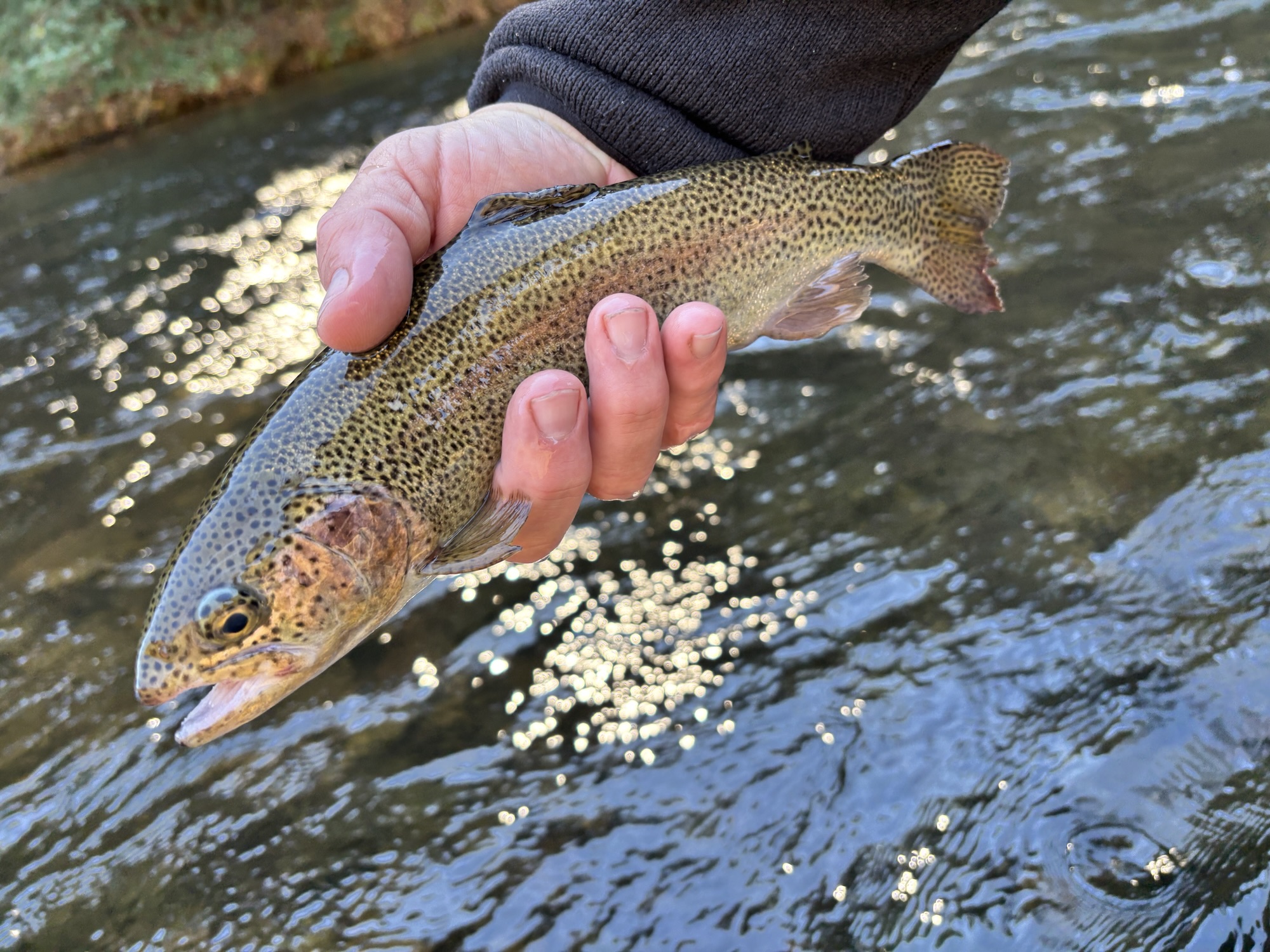
A rainbow.

Then another.
Then a brown.

Suddenly, water that had seemed almost lifeless started producing fish.
It wasn’t magic.
It just felt like magic because I had finally stopped trying to make the river conform to my preferred method.
“Well, It Looks Like It’s Working”
Later, while I was catching fish, another angler came over and asked what I was doing.
He hadn’t been having much luck either.
I explained my situation.
I told him I’d spent the first couple of days fishing the way I normally fish, but nothing was working. After enough frustration, I decided it was time to change tactics.
I explained that I had started tight lining and drifting tiny size 20 emergers and midges.
He watched for a moment and said something along the lines of:
“Well, it looks like it’s working.”
He was right.
The fish were providing the evidence.
But then he said something that stuck with me.
He told me he just didn’t feel like that was fly fishing.
And I understood exactly what he meant.
Because for years, I had felt the same way.
I’ve always enjoyed the traditional aspects of fly fishing—the cast, the presentation, watching a dry fly drift naturally on the surface, or swinging a streamer through a piece of water.
Tight lining tiny flies wasn’t necessarily what I had envisioned when I thought about fly fishing.
But standing there after two days of not catching anything, I had to look at it differently.
I told him I understood where he was coming from because I had felt the same way for years.
But here’s the thing:
The fish don’t care what we think fly fishing is supposed to look like.
They care about what is available in their environment.
And if you want to catch them, sometimes you have to change with that environment.
Sometimes You Have to Fish the Environment
That’s probably the biggest lesson I took away from this trip.
You can’t always expect the environment to adapt to you. Sometimes you have to adapt to the environment.
Water temperatures change.
Flows change.
Insects change.
Light changes.
Weather changes.
And trout behavior changes right along with them.
The fish don’t have a responsibility to eat the way we want them to eat.
Our responsibility as anglers is to recognize what the environment is telling us and respond accordingly.
That doesn’t mean abandoning everything you’ve learned.
It means using your experience to recognize when your experience isn’t enough.
There’s a difference between fishing your confidence and fishing your ego.
Confidence says:
“This has worked for me before.”
Ego says:
“I’m not changing because this is how I fish.”
The river doesn’t care which one you choose.
The Trap of Experience
There’s something I’ve learned after decades of fishing:
Experience gives you confidence, but confidence can become stubbornness.
Experience tells you what has worked before.
It doesn’t guarantee that it will work today.
Every river is different.
Every season is different.
Water temperatures change. Flows change. Barometric pressure changes. Hatches change. Fish behavior changes.
And sometimes the biggest variable is the angler.
I’ve watched this happen many times over the years.
An angler gets locked into a particular fly, retrieve, depth, or technique because it worked yesterday.
Then the conditions change.
The fish change.
But the angler doesn’t.
That’s when experience becomes a handicap instead of an advantage.
The Fly Box Isn’t Always the Answer
Watching those other anglers change flies over and over reinforced something I was learning myself.
Sometimes we’re looking for the answer in the wrong place.
We think:
Maybe they want a different color.
Maybe they want a smaller fly.
Maybe they want a larger fly.
Maybe they want something with more flash.
And sometimes that’s exactly right.
But sometimes the fly isn’t the problem.
The problem is where it is.
Or how fast it’s moving.
Or how deep it’s traveling.
Or whether it is actually behaving like the food trout are seeing in the current.
A perfect imitation presented incorrectly is still an incorrect presentation.
That’s a lesson I should have remembered sooner.
What I Should Have Done Earlier
Looking back, I probably should have started experimenting sooner.
After the first day, I could have spent more time watching the water instead of trying to force the same approach.
After the second day, the message should have been obvious.
The fish were telling me something.
I simply wasn’t listening.
That’s one of the most valuable skills an angler can develop: learning to recognize when the fish are giving you information.
If you’re not catching fish, don’t automatically assume you need a better fly.
Sometimes you need a better observation.
Look at the surface.
Watch the current.
Study where fish are holding.
Look for subtle rises.
Pay attention to what insects are moving through the water.
Think about water temperature.
Watch what the birds and other anglers are telling you.
Then ask yourself whether your presentation actually matches what you’re seeing.
A Few Lessons I’ll Carry Forward
This trip reinforced several things I’ll be carrying into the next trout season.
Don’t confuse confidence with certainty.
Confidence is useful. Certainty can get you stuck.
Let the fish dictate the presentation.
If they’re feeding near the bottom, fish deeper. If they’re taking emerging insects, adjust your fly size and position. If they’re refusing a conventional presentation, change the presentation—not just the fly.
Don’t wait until you’re desperate to experiment.
I had to go several days without catching fish before I finally tried a technique I’d avoided for years.
I should have experimented earlier.
Change with the environment.
This may be the most important lesson.
The river isn’t going to change because you want it to fish a certain way.
If the temperature drops, insects change.
If flows change, holding water changes.
If the food source changes, trout behavior changes.
And when the fish change, your tactics need to change with them.
Pay attention to what other anglers are doing—but don’t blindly follow them.
Watching several anglers change flies repeatedly without success told me something important.
Sometimes the answer isn’t another pattern.
Sometimes the entire approach needs to change.
Sometimes You Have to Start Over
That’s probably the biggest lesson I took away from this trip.
There are times when fishing isn’t about finding the right fly.
It’s about admitting that your current strategy isn’t working.
That can be difficult when you’ve been fishing for decades.
You develop habits.
You develop confidence.
You develop a mental library of techniques that have produced fish for you over the years.
But the river doesn’t owe you the same conditions twice.
Sometimes the smartest thing you can do is throw away the plan.
Start watching again.
Start thinking again.
And try something you’ve never been comfortable with.
For me, that meant standing in a November river after several frustrating days, tying on tiny size 20 emergers and midges, and finally giving tight-line presentation a legitimate chance.
The reward wasn’t just a few rainbows and browns.
It was the reminder that even after 35-plus years of fly fishing, there is still something to learn every time I step into the water.
And maybe that’s what keeps us coming back.
Not knowing everything.
But knowing enough to recognize when it’s time to try something different.
The fish don’t care how long you’ve been fishing. They only care about what you put in front of them.
And sometimes, if you want to catch them, you have to be willing to change with the environment.
That’s a lesson worth remembering on every river.
Final Thought
The next time you’re standing in a river wondering why nothing is working, don’t immediately change flies.
Stop.
Watch.
Listen.
Rethink your assumptions.
The breakthrough may not be another pattern in the fly box.
It may be a completely different way of presenting the fly you already have.
Sometimes catching the next trout starts with being willing to admit that what worked yesterday isn’t working today.
And sometimes, the best fishing lesson is the one the fish force you to learn.
For me, that lesson came after two days of doing things the way I’ve always done them.
I finally changed.
The fish responded.
And somewhere in that November river, I was reminded that after 35 years of fly fishing, being willing to learn something new may be more important than knowing what you’ve always done.
Photography on the Water
November trout fishing also reminded me why I carry a camera even when the fishing isn’t cooperating.
The slow periods are when you have time to notice the details—the way low autumn light hits the water, the texture of the riverbank, the subtle movement of current around rocks and seams, and the character of the landscape surrounding the river.

Those moments tell the story of a trip just as much as the fish do.

For Beyond the Cast, photography has always been part of the experience. The goal isn’t simply to document the trout. It’s to capture the places, conditions, and moments that make the trip worth remembering.

Sometimes the best photograph of the day comes before the first fish is caught.
And sometimes the photograph that means the most isn’t the biggest fish.
It’s the image that reminds you exactly where you were when you learned something new.
Leave a Reply